10 September 2026
The Rhythm of a Treatment – Why Arrival Should Never Be Rushed Slowing down, breathing and conscious transitions throughout a treatment
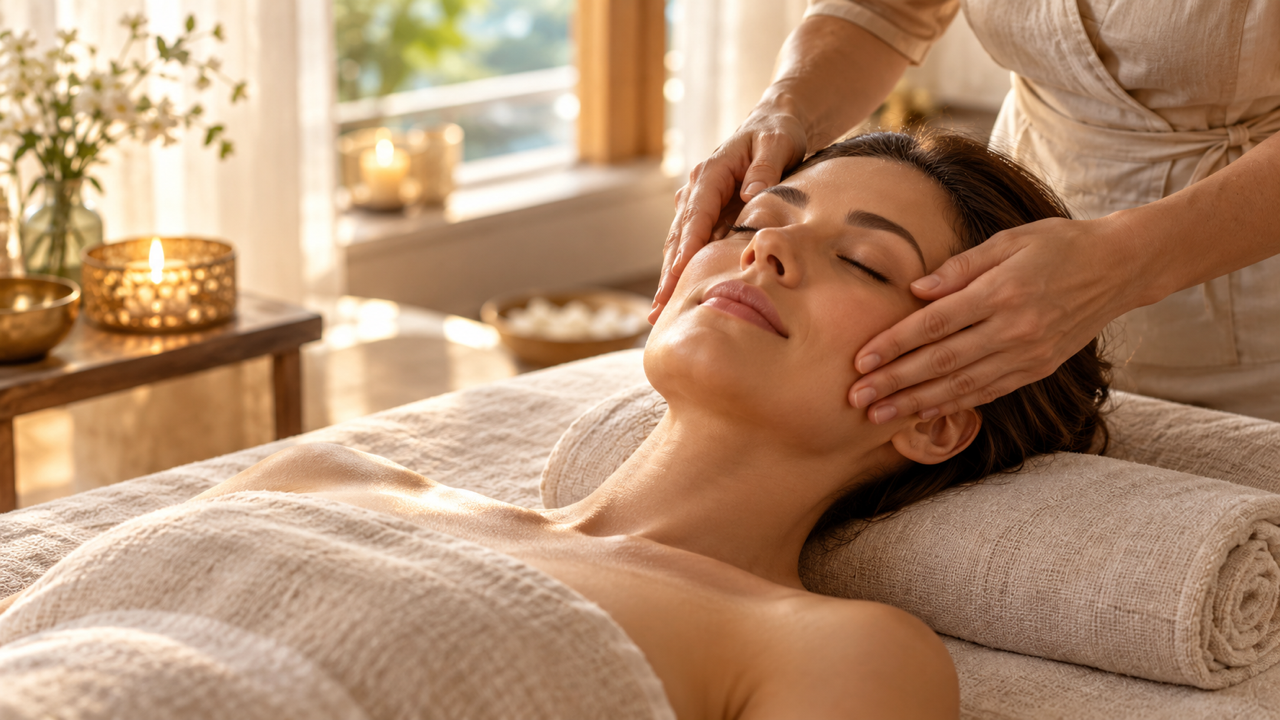
It begins the moment the guest enters the space. As they put down their bag. As they look around. As they take a seat, answer a few questions and gradually become quieter.
Their body may have arrived, but their thoughts may still be somewhere else.
Perhaps they have come straight from work. Perhaps they are still replaying an earlier conversation in their mind, planning their next task or simply finding it difficult to let go of the pace at which they have been functioning all day.
Arrival is therefore not a single moment.
It is a process.
And this process cannot be rushed.
Every treatment has its own rhythm
A treatment is not a collection of movements performed one after another.
It does not become valuable because we fit as many techniques into it as possible. Nor does it become complete simply because we fill every minute with activity.
It has its own rhythm, arc and inner order.
There are moments when we lead. At other times, we follow. Sometimes the movement carries greater significance; at other times, it is the silence between two movements that matters most.
Touch that is too fast, rushed changes and constant interruptions can make it more difficult to relax. Just as the guest’s body begins to adjust to one sensation, another one follows. Just as they begin to let go, a new stimulus appears.
The rhythm of a treatment is revealed not only in the way our hands move.
It can also be felt in whether we allow the guest enough time to arrive in the present moment.
Slowing down is not the same as being slow
Conscious slowing down does not mean that every movement must necessarily be slow.
It means that nothing is done in a hurry.
The therapist does not race ahead mentally. They do not think about the next technique while still performing the previous one, nor do they try to fill every moment of silence at all costs.
They remain present with what they are doing.
The rhythm may change gently. It can contain more dynamic and flowing sections, followed by quieter and deeper phases. What matters is not uniformity, but continuity.
The guest should not experience a series of separate movements, but one safely guided process.
Breathing as an invisible compass
Breathing can tell us a great deal.
We do not need to observe or interpret it constantly. Even so, it can help us sense how the guest’s state changes throughout the treatment.
At the beginning, their breathing may be shallower, faster or less regular. As inner tension gradually decreases, it will often deepen and become calmer on its own.
This should never be forced.
It is not the therapist’s role to tell the guest how to breathe. Often, it is enough for us to breathe calmly, avoid rushing and create a rhythm in which the other person also has the opportunity to slow down.
Our own breathing supports our presence as well.
It brings us back to the moment. It helps us notice when we begin to rush, when we lose the connection or when we start chasing the next step instead of sensing what is happening right now.
True attention is revealed in the transitions
The quality of a treatment is determined not only by the techniques we use, but also by how we move from one phase to the next.
What happens when we change the intensity of the touch?
How do we move from one area to another?
Does the connection break, or can the guest continue to feel the safe presence of our hands?
Transitions are often barely noticeable, yet they are what hold the treatment’s entire arc together. If they are too abrupt, the body may return to a state of alertness. If they are conscious and continuous, the guest does not have to readjust with every change.
A good transition does not have to be impressive.
It is good precisely because it is almost unnoticeable.
The seven steps of Zen Blessing as an inner arc
The seven steps of Zen Blessing are not seven rigidly separated tasks.
They form a natural path along which the treatment guides the guest – and the therapist alongside them.
Attunement
At this stage, we are not yet trying to achieve anything.
We pay attention. We arrive. We allow the pace of the outside world to gradually recede into the background.
Attunement should not be shortened simply because we want to begin the “real” treatment. Arrival itself is already part of the treatment.
Connection
Touch asks for trust.
A connection is not created automatically the moment our hands make contact with the guest. The body may need time to accept the touch, become familiar with its rhythm and feel safe in the situation.
There is no room for impatience in connection.
Flow
Once the connection has been established, the movements can gradually begin to merge into one another.
Separate techniques no longer simply follow each other. Instead, one continuous process begins to unfold. The hand does not merely perform a task – it guides, follows and responds.
Flow is not choreographic perfection. It is continuity.
Deepening
Deepening cannot be produced on command.
We cannot tell the body that it is now time to relax completely. We can only create the conditions in which this may naturally happen.
This often requires fewer movements, longer presence and more silence.
Renewal
A treatment cannot remain at its deepest point forever.
Energy and attention begin to shift gently. The movements may gradually become a little more vibrant while still preserving the calm established during the previous phases.
Renewal is not a sudden awakening. It is a gradual return.
Message
Every treatment may carry a personal insight or an inner impression.
It does not have to be a profound realisation. Sometimes it is simply the experience of pausing. Of receiving attention. Of remaining in silence. Or of not having to achieve or perform anything for a few minutes.
The message does not always have to be put into words.
Some things the guest simply carries away with them.
Closure
Closure is not the quick performance of the final movement.
It is just as important a part of the treatment as the beginning. The guest needs time to return, reorient themselves and reconnect with the outside world.
If we do not rush their arrival, we should not rush their departure either.
During closure, we do not abruptly cut off the process. We gently bring it to completion.
More does not always offer more value
As therapists, we may easily feel that we provide real value only when we use many techniques, work continuously and leave no minute “empty.”
Yet silence is not empty.
Calm is not inactivity.
A sustained touch, a conscious pause or a gentle transition may sometimes offer more than another impressive movement.
The guest will not count how many techniques they received. They are far more likely to remember how they felt during the treatment.
Did they have enough time to arrive?
Did they feel safe?
Did they feel that someone was truly paying attention to them?
The therapist’s rhythm is present too
The pace of a treatment is not influenced only by the guest’s state.
We also bring our own rhythm into the space.
If we are tense, if our thoughts are already with the next guest or if we feel that we are running behind, this may appear in our movements. Perhaps we reach for our tools more quickly, make abrupt changes or unconsciously shorten the parts that need more time.
This is why attunement is not only for the guest.
It also offers the therapist an opportunity to pause, breathe and arrive with the person who is in front of them at that moment.
Not with the previous guest.
Not with the next task.
With this one encounter.
Am I following the rhythm or simply completing tasks?
A treatment protocol is important. It provides safety, structure and a professional framework.
But a protocol alone is not presence.
The sequence of movements can be learned. Sensing the rhythm of a treatment, however, requires attention, practice and inner calm.
From time to time, it is therefore worth asking ourselves:
Am I truly following the rhythm of the treatment, or am I simply trying to finish all the tasks?
We may perform every prescribed step precisely and still feel that something is missing.
The space in which the guest does not have to hurry.
The silence in which, finally, nothing is expected of them.
The touch that does not race ahead, but remains with them.
The rhythm of a treatment cannot be measured with a stopwatch.
It can be felt in the way the guest gradually arrives – first in the space, then in their body and finally, perhaps, a little closer to themselves.
Do you give your guest enough time to arrive – and do you truly arrive with them?
Vígh Tímea
Zen Blessing Massage®